
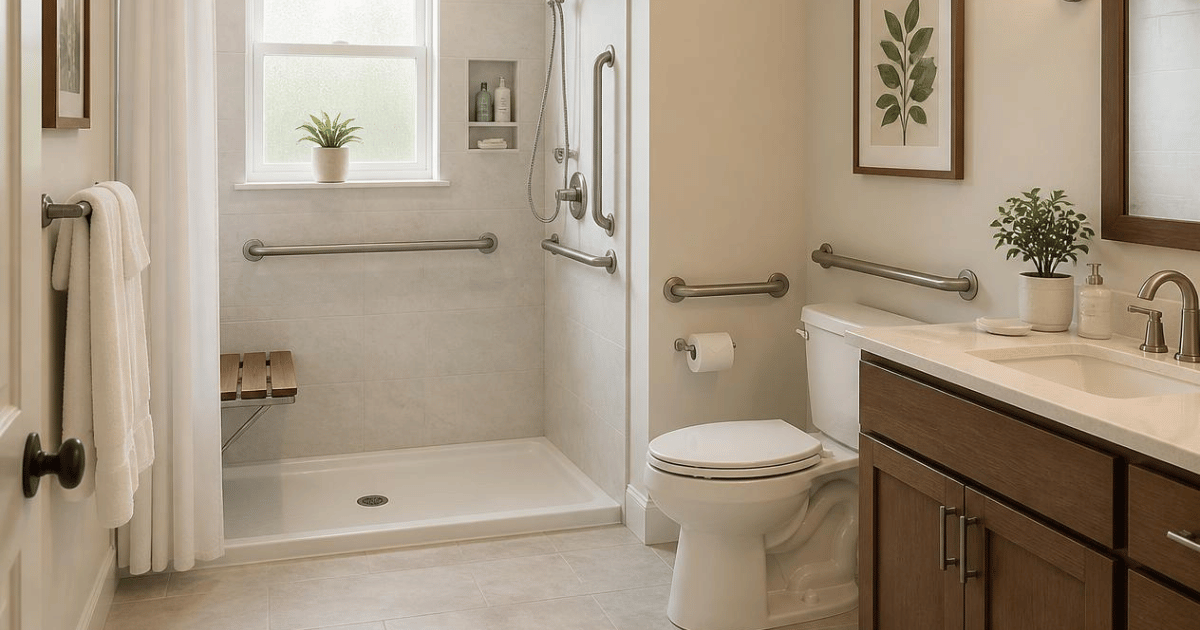
Bathroom safety after hospital discharge deserves attention before someone comes home from a hospital or rehabilitation stay. A bathroom that worked well before a hospital or rehabilitation stay may become much more difficult to use during recovery.
Someone returning home may have less strength, reduced balance, limited endurance, or new mobility equipment. They may be using a walker, cane, wheelchair, shower chair, or other support for the first time. Even familiar tasks, getting on and off the toilet, stepping into a shower, turning around, reaching for a towel, or walking to the bathroom at night, may require more effort than they did before.
That is why reviewing bathroom safety after hospital discharge can be an important part of preparing the home.
The goal is not to assume that recovery will be difficult or that permanent remodeling is necessary. The goal is to identify potential problems before discharge day, while there is still time to ask questions, rearrange the room, obtain recommended equipment, or contact an appropriate professional.
This guide focuses on practical features of the bathroom. It is educational information, not medical advice or a professional home-safety assessment. Always follow the instructions provided by the person’s physician, nurse, occupational therapist, physical therapist, discharge planner, or other healthcare professional.
For a broader room-by-room review, use our Hospital Discharge Home Checklist to check entrances, walking routes, bathrooms, sleeping areas, lighting, equipment, and available help before they come home.
Start With the Route to the Bathroom
Bathroom safety begins before someone enters the bathroom.
Consider the complete route from the person’s likely sleeping or recovery area to the bathroom. If they will be walking at night, imagine that route when the house is dark and the person is tired.
Look for:
- Loose rugs or runners
- Electrical cords
- Pet bowls
- Small tables or decorative objects
- Narrow turns
- Clutter near the doorway
- Changes in floor height
- Poor lighting
- Furniture that restricts the path
- Doors that are difficult to open
A clear path does not necessarily mean removing everything from the home. It means making the route as predictable and unobstructed as possible.
If the person will use a walker or wheelchair, check whether there is enough room to move through the hallway and approach the bathroom door. A route that is comfortable for someone walking independently may be too narrow for mobility equipment or for another person providing assistance.
You can also consider whether the bathroom door should remain open during the initial recovery period, if privacy and household circumstances allow. A door that is difficult to open or close may create an unnecessary obstacle.
Check the Bathroom Entrance and Doorway
The bathroom entrance deserves a close review.
Ask:
- Does the door open in a way that blocks access?
- Is the doorway wide enough for the expected mobility equipment?
- Is there a threshold that could catch a foot or walker?
- Can the person operate the door handle easily?
- Is there enough space to turn around once inside?
- Could another person assist without being trapped behind the door?
A person with limited balance may have difficulty stepping over even a small threshold. A walker may catch on an uneven transition between flooring surfaces. A wheelchair may require more turning space than the room currently provides.
Do not assume that the person will be able to use the bathroom exactly as they did before hospitalization. Ask the healthcare team what equipment or level of assistance is expected, then compare those needs with the actual bathroom layout.
Review the Toilet Area
Getting on and off the toilet can require significant leg strength, balance, and control.
Review the height of the toilet, the available space around it, and whether the person can approach and leave it safely. A low toilet may be particularly difficult for someone with weakness, pain, balance concerns, or limited knee or hip movement.
Potential questions include:
- Is the toilet too low for the person to sit down and stand up comfortably?
- Is there enough space to approach from the expected direction?
- Is the floor stable and dry?
- Is lighting adequate?
- Is support available where it is actually needed?
- Can the person reach toilet paper and other necessities without twisting or leaning too far?
A towel bar, sink edge, or other bathroom fixture should not automatically be treated as a support bar. These items may not be designed to bear a person’s weight and could pull loose or cause a fall.
If a raised toilet seat, grab bar, toilet safety frame, or other equipment is recommended, follow the manufacturer’s installation instructions and seek professional help when needed. The appropriate equipment depends on the person, the bathroom, and the instructions from their healthcare team.
Planning for bathroom safety after hospital discharge means comparing the bathroom with the person’s expected mobility and assistance needs.
Examine the Shower or Tub Entry
The shower or tub entrance is one of the most important areas to review.
Stepping over a tub wall or into a shower can be difficult when someone has reduced balance, weakness, pain, or limited ability to lift a leg. Water and soap can also make surfaces slippery.
Look at:
- The height of the tub or shower threshold
- Whether the person can step over it safely
- Whether a walker can be positioned nearby
- Whether the floor becomes slippery when wet
- Whether the shower door or curtain interferes with entry
- Whether there is enough room for assistance
- Whether water reaches the floor outside the bathing area
- Whether controls and shelves are easy to reach
Do not assume that a person who could use the shower independently before hospitalization can do so immediately after returning home. Their needs may change temporarily during recovery.
A shower chair, tub bench, handheld shower head, transfer bench, or other equipment may be appropriate in some situations. However, equipment should be selected and used according to professional guidance and manufacturer instructions.
Look at Support Locations
Support should be available where the person needs it, not simply wherever there is an open wall.
A properly installed grab bar may help with specific movements, such as:
- Entering or exiting a shower
- Lowering onto or rising from the toilet
- Turning or repositioning
- Maintaining balance near wet surfaces
The correct location, height, orientation, and attachment method matter. A grab bar that is installed in the wrong place may not provide useful support. A bar attached improperly may pull away from the wall.
Do not use a towel rack as a substitute for a grab bar. Towel racks are generally designed to hold towels, not support body weight.
The National Institute on Aging also recommends measures such as bathroom grab bars, good lighting, and reducing slip hazards in the home.
For permanent or structural installations, consult a qualified professional. If the person is working with an occupational therapist or physical therapist, ask whether they can provide recommendations based on the person’s movement and transfer needs.
Reduce Slip and Trip Hazards
Bathroom floors can become hazardous when water, soap, loose mats, or clutter are present.
Review:
- Bath mats
- Shower mats
- Loose rugs
- Floor transitions
- Water near the tub or shower
- Soap or shampoo on the floor
- Damp clothing or towels
- Clutter near walking areas
- Uneven or damaged flooring
A mat that slides across the floor can create a problem rather than solve one. If a bath mat is used, it should be appropriate for the surface and secured according to the manufacturer’s guidance.
Keep frequently used items in stable, easy-to-reach locations. Reaching into a high cabinet, bending deeply, or stepping onto a stool can create unnecessary risk during recovery.
It may also help to wipe up water promptly and keep towels within comfortable reach. The person should not have to walk across a wet floor to retrieve a towel.
Improve Bathroom Lighting
Good lighting is a simple but important part of bathroom safety after hospital discharge, especially along the route used at night.
Check whether the person can:
- Find the bathroom route safely
- Identify obstacles on the floor
- See changes in floor height
- Locate the toilet and shower
- Reach the light switch
- Turn on lighting before entering a dark area
Reviewing bathroom safety after hospital discharge before the return date gives families time to make simple changes or ask the right questions.
A night-light may help, but it should not create a trip hazard or block the walking path. Consider lighting along the route from the bedroom to the bathroom as well as inside the bathroom itself.
Glare can also affect visibility, particularly on shiny or wet surfaces. The goal is even, useful illumination that helps the person see where they are stepping and what they are reaching for.
Keep Everyday Items Within Reach
Bathroom preparation is not limited to large equipment.
During recovery, it may be helpful to place everyday items where they can be reached without excessive bending, stretching, or twisting.
Depending on the person’s needs, this could include:
- Towels
- Soap
- Shampoo
- Toothbrush and toothpaste
- Toilet paper
- Personal-care items
- Clothing
- A phone or emergency contact method
Avoid placing important items on the floor or in locations that require balancing while reaching. A person should not need to stand on one leg, lean across the shower, or climb to access basic supplies.
If the person will need assistance, organize items so a caregiver can help without blocking the doorway or forcing the person to move unnecessarily.
Consider Privacy and Emergency Access
Bathroom safety also includes planning for situations in which help may be needed.
Consider:
- Whether the person can call for help
- Whether a phone or alert device is accessible
- Whether the bathroom door can be unlocked from outside in an emergency
- Whether a caregiver can enter and assist
- Whether the person understands how to request help
- Whether the household has agreed on what to do if the person falls
Do not place a phone where it could be reached only by stepping into the shower or leaning dangerously. Keep emergency contact information accessible in another location as well.
If the healthcare team has provided specific instructions about supervision or assistance, those instructions should take priority.
Ask the Healthcare Team Specific Questions
Before discharge, families may want to ask questions that connect the person’s needs with the bathroom’s actual layout.
Useful questions include:
- Is the person allowed to shower independently?
- Does the person need assistance with transfers?
- Is a shower chair or tub bench recommended?
- Is a raised toilet seat appropriate?
- Should the person use a walker inside the bathroom?
- Is weight-bearing limited?
- Are there movement restrictions?
- Does the person need someone nearby during nighttime bathroom trips?
- Should the bathroom be on the same floor as the recovery area?
- Who can help evaluate equipment or installation?
A discharge planner, occupational therapist, physical therapist, nurse, or other qualified professional may be able to provide guidance specific to the person’s condition and abilities.
Use a Room-by-Room Home Readiness Check
The bathroom is only one part of preparing the home.
Entrances, walking paths, bedrooms, lighting, and everyday living areas may also need attention before someone returns from the hospital or rehabilitation. For more practical home-preparation guidance, visit our Resources page.
The Home Readiness Check walks through common areas of the home with simple questions. It is free, takes only a few minutes, and does not require medical records or sensitive health information.
Final Bathroom Safety Checklist
Before someone comes home, review whether:
- The route to the bathroom is clear.
- The bathroom doorway works for the mobility equipment or assistance expected.
- The floor is stable and as slip-resistant as possible.
- Water can be controlled and cleaned up promptly.
- The toilet is practical for the person’s current abilities.
- Shower or tub entry has been evaluated.
- Support equipment, if used, has been selected and installed according to the relevant professional and manufacturer guidance.
- Frequently used items are within comfortable reach.
- Lighting is adequate during the day and at night.
- A method of calling for help is available.
- The healthcare team’s instructions have been followed.
- The person knows when to ask for assistance.
A few simple changes may be enough. In other situations, the bathroom may require equipment, professional installation, or a different recovery arrangement. The most important step is to identify the potential problem before it becomes an urgent problem.
Bathroom Safety After Hospital Discharge: Prepare Before Discharge Day
Bathroom safety after hospital discharge should be considered as part of the larger home-preparation process.
You do not have to predict every possible need or permanently change the entire home. Start by looking at the bathroom through the eyes of the person who will use it during recovery. Think about how they will enter, turn, sit, stand, bathe, reach, and move through the space.
Then compare what you observe with the guidance provided by the healthcare professionals involved in their care.
Discharge Ready Home is based in Port Charlotte, Florida, helping families prepare the physical home before someone returns from a hospital or rehabilitation facility.
The Home Readiness Check can help you review the bathroom and other everyday areas of the home before someone comes home from the hospital or rehabilitation.
This article is for general educational purposes only. It is not medical advice, a professional home inspection, or a substitute for guidance from qualified healthcare professionals.